Why freshly milled?
Why we mill our own
Most bread starts with a bag of flour. Ours starts with a jar of wheat berries — small, hard, golden seeds that look a bit like brown rice. On bake day we pour them into a small stone mill in our kitchen, and a few minutes later we have flour that is still slightly warm and smells like a wheat field after rain.
The mill itself is not much bigger than a bread bin. Inside it, two stones — one still, one turning — grind about 250 grams of wheat a minute, which is roughly a loaf's worth of flour every minute or so. It's noisy, it's dusty, and it's our favourite part of bake day.
People often ask why we go to the trouble. This page is our answer. It isn't a lecture, and we won't promise that our bread will change your life. It's what we have learnt, from books, from other millers and bakers, from two videos we enjoyed (you'll find them near the end), and from a lot of loaves — some of them very flat.
We think fresh flour makes better bread, and we think it's worth knowing where your flour comes from. The story goes back thousands of years, and it starts with a single seed.
Inside a wheat berry
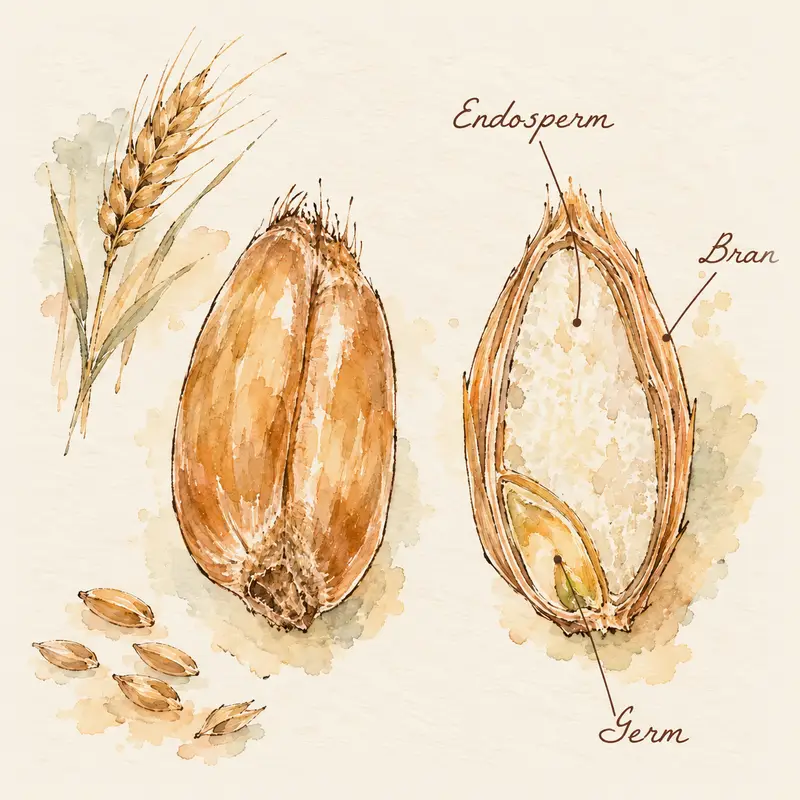
A wheat berry is a whole seed, and like most seeds it is built to wait. Sue Becker, who has been milling at home since the early 1990s, explains its three parts beautifully in one of the videos below, and we've borrowed her way of thinking about them.
The outside is the bran: thin, tough layers that protect the seed. The bran holds most of the grain's fibre, along with minerals and some of its B vitamins. When you see brown flecks in wholemeal bread, that's bran.
Tucked into one end is the germ — the part that would grow into a new wheat plant if you planted the seed. Think of it as the seed's packed lunch for the journey: it is small, but rich in oils, vitamin E and more B vitamins.
Everything else is the endosperm, the pale, starchy middle that feeds the young plant. It is mostly starch, with some protein. The endosperm is what white flour is made of. When wheat is turned into white flour, the bran and germ are separated and sold on, and the endosperm is ground fine.
Here is the clever part. As long as the seed stays whole, it keeps its oils apart from the air and from the enzymes that break them down. Stored cool and dry, whole wheat berries keep for years. The moment you grind them, that protection is gone. That one fact explains most of the history that follows — and why we mill our flour the way we do.
Two stones and a patient miller
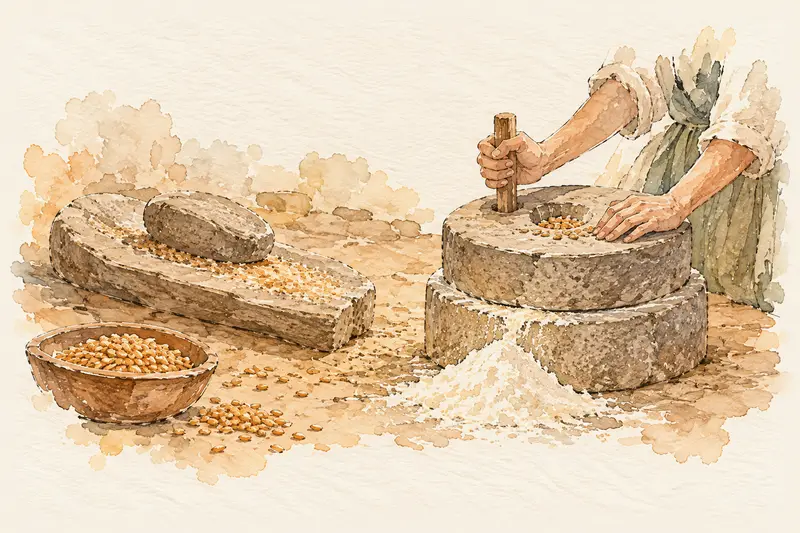
For most of human history, flour was made by rubbing grain between two stones. The oldest tool for it is the saddle quern: a flat stone with a hollow worn into it, and a smaller stone pushed back and forth on top, usually by hand, usually for hours. Later came the rotary quern, two round stones with a handle, which let a person grind far more in a day.
Then people put water and wind to work. The Romans built water-powered mills, and by the Middle Ages mills were everywhere — England's Domesday Book, written in 1086, counts thousands of them. Many villages depended on their mill, and the miller was usually paid in grain: he kept a share of every sack he ground.
The Medieval Way channel has a lovely explanation of how a mill works, which we recommend below. The idea is simple and very old. A heavy stone, the bed stone, lies still. Another, the runner, turns on top of it. Grain trickles in through a hole in the middle of the runner called the eye. Grooves cut into both stones, the furrows, act like scissors: they slice the grain and carry the flour out towards the edge. The miller sets the gap between the stones — closer for fine flour, wider for coarse — and every few weeks the stones had to be dressed, the furrows re-cut by hand with a sharp hammer. Some of the most prized millstones in Europe came from quarries near La Ferté-sous-Jouarre in France, valued for their hard, sharp-edged stone.
South Africa has its own milling history. In Cape Town you can still visit Mostert's Mill, a windmill built in Mowbray in 1796. It was badly damaged in the 2021 Table Mountain fire and has since been restored. Our mill is a great deal smaller, but it works on the same principle: two stones, one still and one turning, and flour that comes out whole.
Iron rollers and very white bread
White bread is not a modern invention. For thousands of years people have sifted flour to make it whiter, and white bread was a sign of wealth. Rich Romans ate fine white loaves while poorer people ate darker, coarser bread. In medieval England, the best white bread was kept for the lord's table. White was special, and it was expensive, because sifting the bran out of stone-ground flour by hand is slow work.
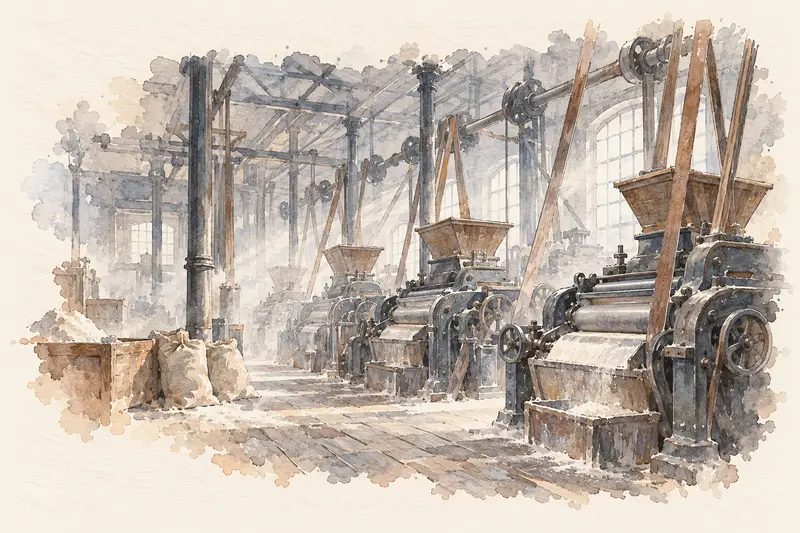
In the nineteenth century that changed. Engineers in Hungary and Switzerland developed mills that crushed grain between pairs of iron or porcelain rollers instead of stones (steel came later), and from the 1870s these roller mills spread quickly, especially in the big wheat countries. A roller mill works in stages: the grain passes through one pair of rollers after another, with sieves in between, and at each stage more of the bran and germ are separated from the white endosperm. The result was flour whiter than any stone mill could make, produced in enormous quantities.
To make white flour this way, roughly a quarter of the grain is taken out. Most of it — the bran and the germ — goes to animal feed or is sold separately as wheat germ and bran.
It's tempting to tell this as a story with villains, and some videos do. We don't think it needs one. White flour lasts much longer on a shelf, because the oily germ is gone. It could be milled in one place and shipped across a country without going off. It made soft, light bread that people had wanted for centuries, at a price almost everyone could afford. Those were real benefits. But something was lost too, and for a long time nobody noticed.
Putting some of it back
As more and more people ate refined flour and meal, doctors began to see the effects of what had been taken out. Diets that depended heavily on refined grains could leave people short of some B vitamins and iron. In parts of the world, including South Africa, a disease called pellagra was linked to diets that relied heavily on maize and lacked niacin, one of the B vitamins.
The answer many countries chose was fortification: adding vitamins and minerals back to flour at the mill. South Africa made it law in 2003. Since October that year, millers have had to fortify bread flour and maize meal with a set of vitamins and minerals, including vitamin A, several B vitamins such as thiamine, riboflavin, niacin, vitamin B6 and folic acid, and iron and zinc. It has been an important public-health measure, especially for mothers and babies: since folic acid was added to flour, fewer babies in South Africa have been born with certain serious birth defects of the spine and brain. It works because it reaches people through the bread and porridge they already eat.
So we are glad of fortification, and grateful for the people who worked for it.
What fortification does is put back a short list of nutrients. A whole grain carries more than that. The bran brings fibre and minerals such as magnesium; the germ brings vitamin E and healthy oils; and all of it comes in the combination the plant made. Stone-milled wholemeal keeps all of it, because nothing was taken out. That's all we mean when we say our flour is whole: every part of the berry that went into the mill comes out in the flour, and goes into your loaf.
Fresh is a flavour
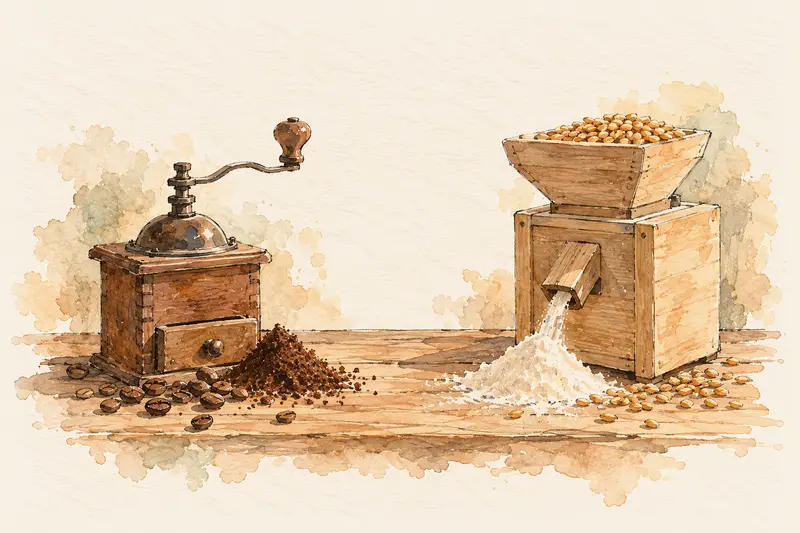
If you've ever ground coffee beans just before brewing, you already understand freshly milled flour.
Whole coffee beans keep their flavour for weeks. Ground coffee starts to lose its aroma almost immediately, because the oils inside the beans meet the air and begin to change. Wheat berries behave in the same way. Whole, they keep for years. Once they are milled, the oils in the germ start to react with the air. Over weeks and months — faster in a warm kitchen — wholemeal flour gradually loses its sweet, fresh smell and can develop a bitter, stale taste. That's why commercial wholemeal flour has a much shorter shelf life than white flour, which has had the germ removed.
So we don't stockpile flour. We keep our wheat as whole berries and mill it close to the time we bake — usually the same day. It is the simplest way we know to put the flavour of fresh flour into the loaf you eat.
What you'll taste, and what we don't claim
Our Farm Loaf tastes of wheat. It's nutty and slightly sweet, with a moist, tender crumb and a crust that tears open in the oven. It is heartier than a supermarket white loaf, and a little denser: bran makes the dough behave differently, so wholemeal needs more water and more patience than white flour. We think that is part of its charm.
If you bake yourself, that's the most useful thing we've learnt: fresh wholemeal flour drinks water. We mix it with water first and leave it to rest before anything else goes in, so the bran can soften and the flour can soak up what it needs. The dough starts out looking far too wet — and ends up as bread with a soft, open crumb. Toast it, and the nutty taste gets even stronger.
Some things we should say plainly. Our bread contains gluten and wheat, and it's baked in a home kitchen, so it isn't suitable for anyone with coeliac disease or a wheat allergy. Freshly milled flour does not change that.
We're also a bakery, not a clinic. Large studies have linked diets rich in whole grains with better long-term health — a 2016 review in the BMJ, which combined results from many studies, is a good place to start if you're curious. But we won't make health promises about our loaves. We bake them because we think they taste better, because we enjoy knowing exactly what goes into them, and because milling the wheat ourselves connects us to a craft that people have practised for thousands of years.
The videos we enjoyed are below. Watch them for the history; they make some claims we don't make ourselves.
Further watching
We enjoyed both for their history. They make some health claims we don’t make ourselves.
Sources
- The Truth About Medieval Stone Milling — Medieval Way (YouTube)
- The Bread Conspiracy Nobody Talks About — Sue Becker on The John Lovell Show (YouTube)
- Whole grain consumption and risk of cardiovascular disease, cancer, and all cause and cause specific mortality: systematic review and dose-response meta-analysis of prospective studies — Aune D. et al., BMJ, 2016
- Regulations relating to the fortification of certain foodstuffs (R.504, 2003) — South African government
- Neural tube defects after folic acid fortification in South Africa — Sayed A.R. et al., Birth Defects Research, 2008
- Mostert's Mill — the mill's own site, Mowbray, Cape Town
- Flour milling in Minneapolis and the new process — Minnesota Historical Society
- The kernel of wheat — Wheat Foods Council
- Gristmill — how stone mills work, Wikipedia